
For anyone joining the fibre optic community for the first time there is plenty of jargon for you to learn. Make sure that you understand some of the following terminology so that when talking to a contractor, client, salesperson and specialist you can make a valuable contribution by understanding what they mean. Hey, it always takes time settling into a new industry, so relax; this just might go toward helping you though.
Singlemode Fibre: Singlemode fibre is a type of fibre cable used for most fibre developments. Essentially, it is a fibre cable with a much thinner core than a multimode cable, streamlining information transferal via different light-wavelengths down the glass ‘tube’.
Multimode Fibre: Contrary to the above, multimode fibre was considered to be the future of fibre development as the larger core allows more space for the transferal of information down the glass ‘tube’. However, as technology advances, the transceivers on either side of the fibre line are becoming so adept at transmitting information that it is not the core space that is the issue; rather it is the speed at which messages are carried. Therefore, multimode is slowly becoming obsolete over the much quicker singlemode variant.

Cladding: Fibre cladding is the synthetic compound used to protect and cover the glass fibre. Don’t mistake cladding for the outer buffer on the overall fibre optic cable (these two terms often get mixed up and confused). The cladding usually takes different colours in relation to the fibre colour code spectrum. These colours are arranged in order as follows: Blue, orange, green, brown, slate, white, red, black, yellow, purple, magenta, aqua.
Buffer: Fibre buffer is the thicker compound that encompasses many fibres and their cladding (or sometimes a single fibre and its cladding). Often a buffer will also incorporate a ripcord (to assist the technician in opening the buffer), a strength-member, and sometimes a protective sheath.

Wavelength Division Multiplexing: This concept lies at the heart of the success of singlemode optical fibre (and fibre optics as a whole). By transmitting information in different wavelengths of light down a fibre optic cable, you can essentially transmit more than one message at exactly the same time. Additionally, information transmitted in this way can work bidirectionally (going in both directions simultaneously).
Fibre Splicing: Fibre splicing is exactly that: splicing or ‘bonding’ two endpoints of a fibre. This means that a break in a fibre line can be repaired, or a fibre line can be extended or shortened at will (although there are obvious pitfalls, because the more splices there are, the higher losses there will be). There are two types of splices: there are fusion splices (which involves ‘melting’ together two endpoints VERY accurately through the use of an electrical arc) and mechanical splicing by mechanically joining two endpoints and crimping them together so they stay fixed in their position.
Fibre Transceiver: This device holds the power behind a fibre optic network. A tranceiver is able to transmit AND receive information through a fibre optic cable via light wavelengths, and then convert them into electrical signals (the standard form of communication on devices, breaking down information into various code languages).
Duplex System: A duplex fibre system is a clever way of alleviating the stress on a single fibre pathway by dedicating two fibres to the communication between two points. Information gets sent in a single direction down one line, and then visa versa with the opposing line.

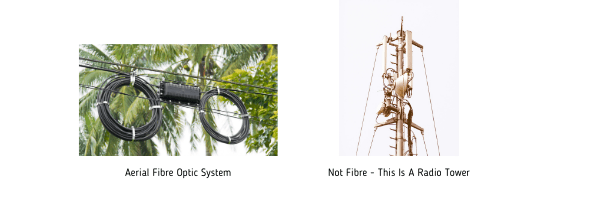
Aerial Fibre Network: To the layman, an aerial fibre network gets confused with aerial towers used for radio frequency signals. For aerial fibre, think of it as a replacement for traditional telephone line poles. That’s exactly what it looks like.
Underground Fibre Conduit or Fibre Duct: This is pretty self-explanatory. Although the system often costs a lot more than an aerial system, underground fibre conduit or fibre duct is a good way of protecting the fibre network. Sometimes, fibre cable is laid out in trenches WITHOUT conduit or duct, but this is a very risky form of installation. Fibre cables are Floated or Blown into fibre ducts by using specialised machinery, and the cables can be accessed and distributed within manholes.
Visual Fault Locator: By using a simple laser module, fiber breaks can be exposed. If a VFL is shone into one end of the fibre, a bright light will appear on the other open end. This tool is used by technicians to identify fibre endpoints in relation to the side of the VFL, or it can be used to find breaks in the fibre itself.
Power Meter & Light Source: Fibre optics light sources are measured in decibels (just like sound, although this pertains to light too). A power meter is a device used by fibre optic technicians to measure the output of decibels from a light source on the opposite side of a fibre optic cable. If light is attributed to the cable at a certain strength, the amount of dB (decibels) loss will determine how much power is being lost in the run of the cable.
Optical Time Domain Reflectometer: That’s a big name for quite a simple machine (simple in theory, but difficult to master). An OTDR machine ‘traces’ a fibre cable: this means that it plots the cable from one point to another on a line graph, using the ‘backscatter’ of light as a way of measuring dB loss. dB loss is best measured with a power meter and light source, however to understand where certain ‘events’ lie on a fibre optic cable an OTDR is required. We will do a full blog on the OTDR at a later time so that you may fully understand how the machine works.

 Heavitech