
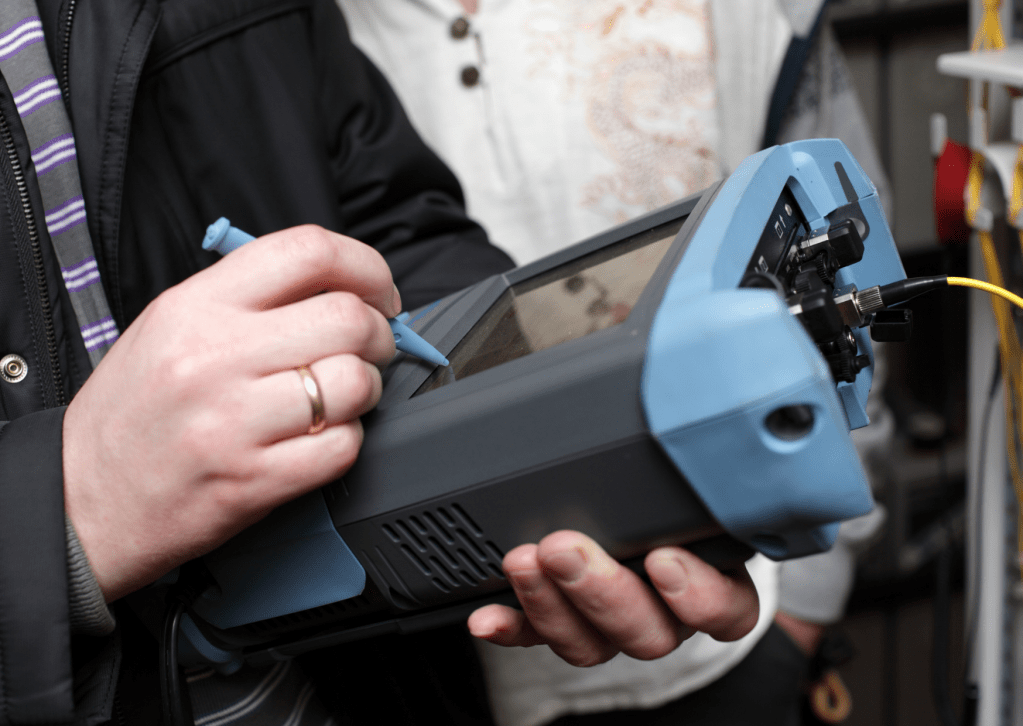
When becoming a fibre optic specialist or installer, you will quickly have to learn the ins-and-outs of OTDR and its measurements. If you are new to the concept of OTDR this post might be very helpful as a short introduction. If you are experienced with the functioning and measurement of an OTDR, this post might give you a little more insight than you previously had. So take a look:
Optical Time Domain Reflectometer (OTDR)
Yip, that’s what OTDR stands for, and it’s quite a mouthful. Simply put, the OTDR is the equipment and the measurement used to check the ‘health‘ of a fibre cable post-installation.
When a measurement is taken with an OTDR we call this the ‘OTDR trace‘. A trace offers the user a graph measurement of the cable, forming a ‘picture’ of what the cable’s integrity might look like. This makes it incredibly helpful when determining if there is a break and where the break occurs along the cable.
Secondly, the OTDR measurement can also be used to check if there are losses along the fibre cable. These losses might be caused due to attenuation, bends or bad splices. An OTDR is so accurate that it can even determine minute losses during instances of good splices.
OTDR & Power Meter
An OTDR is best used in conjunction with a power meter. Why? Because an OTDR is determining the profile of a cable from a single input, and the best way of checking whether the correct losses are measured is with a power source and power meter at both beginning- and end-of-run.
For example: a power meter might pick up that a cable’s end-point is experiencing higher-than-expected losses at the end-of-run. A technician would then use an OTDR to ‘trace’ the cable and find out exactly at which point these losses are being experienced.
During the installation of a fibre network, it is important that a contractor or technician records both a power meter test and an OTDR trace to prove that the line is working to the correct standard. This means that, should there be an issue at a later date, technicians can compare new trace results with older ones, determining that something has occurred between the installation and breakage.

Backscatter Light
Another reason why a technician should always have a power source and power meter handy is because they emulate the transceivers within a working link. An OTDR uses a slightly different method to determine its measurements. An OTDR uses the backscatter of light (transmitted by the OTDR machine) within the cable to determine the amount of loss accumulated, and the location of said losses.
Within a fibre cable there are tiny imperfections, manufactured on purpose, to ensure a reasonable amount of backscatter light for measurement purposes. Additionally, there is more backscatter along bending points and splices within the cable. The OTDR receives the backscatter light, and by clever use of speed and power it can determine the integrity of the cable at an exact point.
As the fibre cable is tested at points further from the OTDR, the attenuation and light loss is experienced more greatly. This means that an OTDR trace will always show itself as a depreciating line graph (unless there is significant reflection off a connector or splice).
An OTDR Graph Measurement

The above is a very basic example of the OTDR trace. As you can see, the graph is a representation of the fibre cable in both distance and and light attenuation. Because attenuation increases as a result of distance from point of contact for the OTDR, the graph will be depreciating.
Reflectance is a good indicator of what is occurring along a fibre line, and the OTDR (and the operator) uses reflectance dB’s to determine what events are taking place. For example, the first event on the left of the graph marks a splice. Due to the joining of two fibre end-points there will be an imperfection through which light is lost. The worse the splice, the higher the dB loss, as there will be less reflectance.
Sometimes high reflectance, such as the event taking place in the middle of the graph, indicates a connector or junction that irregularly reflects a larger amount of light back toward the OTDR. In rare instances, two different makes of fibre cable can result in a ‘gainer’ or ‘loser’ during splicing points. This means that one fibre with a smaller core runs into a fibre with a larger core (and higher attenuation) creating a ‘traffic jam’ effect, creating higher or lower reflectance (depending on the direction of testing).
Test Both Ways
Because of the varied results of an OTDR, and the likelihood of a result being questioned, it is always important to collect two trace results of a fibre cable: first in one direction, and then in the other direction.
Doing this will eliminate any gainers and losers as a result of different cable quality (when two different types of cable are being used). It will also ensure that splice losses and reflectance is being measured accurately. Furthermore, testing the launching point from either end of a fibre cable can only be done from the point in question. An end-of-run result on the OTDR will not provide the necessary information needed to determine if the fibre is terminating correctly (or even where you want it to terminate from).
This small article is, as mentioned, just a short explanation on what OTDR is and how it works. If you require more information on fibre optic testing equipment make sure that you contact Heavitech, and I’ll provide you with as much help as possible.
 Heavitech