Why Farmers Should Be Using Organic Fertilizer

Organic fertilizer is a bit of a contentious issue in the agricultural market within South Africa at present. Many farmers consider the term ‘organic’ as a push by the rich Western market and their obsession with saving the environment – and they’re not wrong. In addition to this, organic fertilizers have not been solving the crisis of rising costs for both commercial and subsistence farmers in South Africa. Additionally, organic fertilizers have hardly broken into the fertile agricultural landscapes in Zambia, Malawi, Mozambique and Zimbabwe. So why should you – the humble farmer – use an organic fertilizer?

A: Because the environment really does benefit from organic.

Synthetic fertilizers are one of the factors responsible for destroying the environment. Whether it is by harming the local ecosystem to make space for more farmland, or by pumping synthetic fertilizers into the local water table, farming (in its efforts to feed the people, it should be said) is not exactly environmentally friendly. Using an organic fertilizer that is not harmful to either the local area’s water, the microorganisms in the soil, the birds, insects, critters and other fauna, is one way in which the farmer may assist in bettering farming’s reputation.

However, organic farming methods can actually be as harmful to the environment as commercial farming (as organic methods actually require more farming land), so we are not recommending that commercial farmers change their methods, only their products.

B: Because your soil’s health depends on organic fertilizer.

If you’re in the farming business, you’ve heard this before: Organic fertilizers lead to the development and growth of healthy microorganisms and bacteria in the soil. This is true on all accounts. Virgin soil is almost always more fertile than soil previously used in the same region for farming, and organic fertilizers are putting the nominal nutrients back into the land in an attempt to create a perfect ‘fallow’ environment. Synthetic fertilizers, which have been heavily used throughout the globe, target the nutrient requirements by the crop and plant, which may sometimes be at odds with the soil’s requirements. This results in what farmers (both subsistence and commercial) are experiencing all over southern Africa – soil infertility. This is because the fertilizers provided by the farmer for that season are measured exactly for that crop cycle. Nothing is provided to the soil.

A well-made organic fertilizer will be developed with the soil in mind, providing the correct NPK profile, alongside other nutrients and minerals, that maintain the perfect soil structure for that region. In South Africa, Zimbabwe, Malawi, Zambia, Lesotho, Mozambique, Swaziland and some of Botswana, the arable land used for crop agriculture has a soil structure that is called alfisol (according to the USDA soil taxonomy system). It is largely similar in nutrient and mineral structure from South Africa all the way to Tanzania. It is with this NPK profile that BioAge organic fertilizer and stimulant is produced.

C: Because it is becoming cost effective.

There is a major conflict in Ukraine, one of the world’s richest agricultural regions, putting huge strain on food markets in Europe. This means that European farmers are under pressure to provide for a European market with rising food costs, who in turn are looking toward synthetic fertilizer manufacturers. And their issue? A lot of the manure-based fertilizers are from Eastern Europe (Russia and Ukraine). Result: huge rise in costs of agricultural fertilizer worldwide as there is less product and more demand.

This is the stage whereby local organic fertilizer producers may just prove to be cost-effective for both commercial and subsistence farmers, or even small-scale farmers and hobbyists.

BioAge organic fertilizers and stimulants are made in southern Africa, and they are made wholly organically within a laboratory environment. They are designed to improve the soil structure without harming microbial life, retaining the perfect alisol NPK structure, providing additives to a plant’s requirements for increased root growth, photosynthesis and crop yield. Furthermore, they are cost effective and competitively priced next to synthetic fertilizers.

Take a look at our organic fertilizers, plant stimulants and herbicide page.

Why Agricultural Products?

HeaviTech has recently decided to expand into the agricultural products sector. With our knowledge and expertise within the fibre optics, telecommunications, and civil engineering sectors, why move towards agricultural products?

According to a recent article from the Department of Statistics of South Africa[1] the fourth quarter of last year saw a massive growth within the agricultural sector. Excellent rainfall across the country, as well as increased prices of animal products, and an increase in wheat production, saw the agricultural sector grow by 12,2%.

While the South African economy still reels from the COVID-19 lockdowns, as well as civil unrest, the agricultural sector as a whole has been performing relatively well, and is one of the few sectors of our economy that consistently displays growth.

That being the case, the focus of much economic studies is based off the results garnered from the large commercial operations that dominate South African agriculture. Far from lamenting this state of affairs, we at HeaviTech, however, feel that the medium to small scale, and ever-growing subsistence categories of farmers, are rather under represented and under catered for.

The changing face of the agricultural sector, with a positive trend in integration and development amongst previously disenfranchised populations, leads us to believe that this category of the agricultural sector needs to be supplied and outfitted with the relevant agricultural products.

This is HeaviTech’s unique vision and it is our goal to ensure that the growing medium to small scale enterprises, as well as subsistence farmers, have access to the best quality agricultural products, at the best prices, ensuring optimal results for their agricultural needs.

From two-wheel tractors, small scale implements, to turnkey poultry solutions, and organic fertilizers, organic weed killers, and other natural growth stimulants, HeviTech aims to be the industry go to for the medium, small-scale, subsistence, and hobbyist farmer. Visit our agricultural products page on our website, and contact us for your farm’s specific needs.


[1] “The South African economy records a positive fourth quarter”, 8 March 2022, https://www.statssa.gov.za/?p=15214, accessed 20 June 2022

How To Maintain A Splicing Machine

how to maintain a splicing machine

If you’re a fibre optic contractor, it is likely that your splicing machines are your pride-and-joy, religiously cleaned and maintained on a daily basis. N0?!? Well, they should be.

Too often I have seen contractors leave their machines open to the elements, generally leaving them dirty, and then blame the machine when arcs leave splices looking horribly deformed and with well over 0.05db losses. A lot of the time, both electrodes and the machine’s health in general can benefit from regular maintenance, and you don’t need to be an incredible technician either.

Cleaning a Splicing Machine

The best way of learning how to maintain a splicing machine is to regularly clean the splicing machine. But you won’t need to break out the water bucket and soap – leave those very far away.

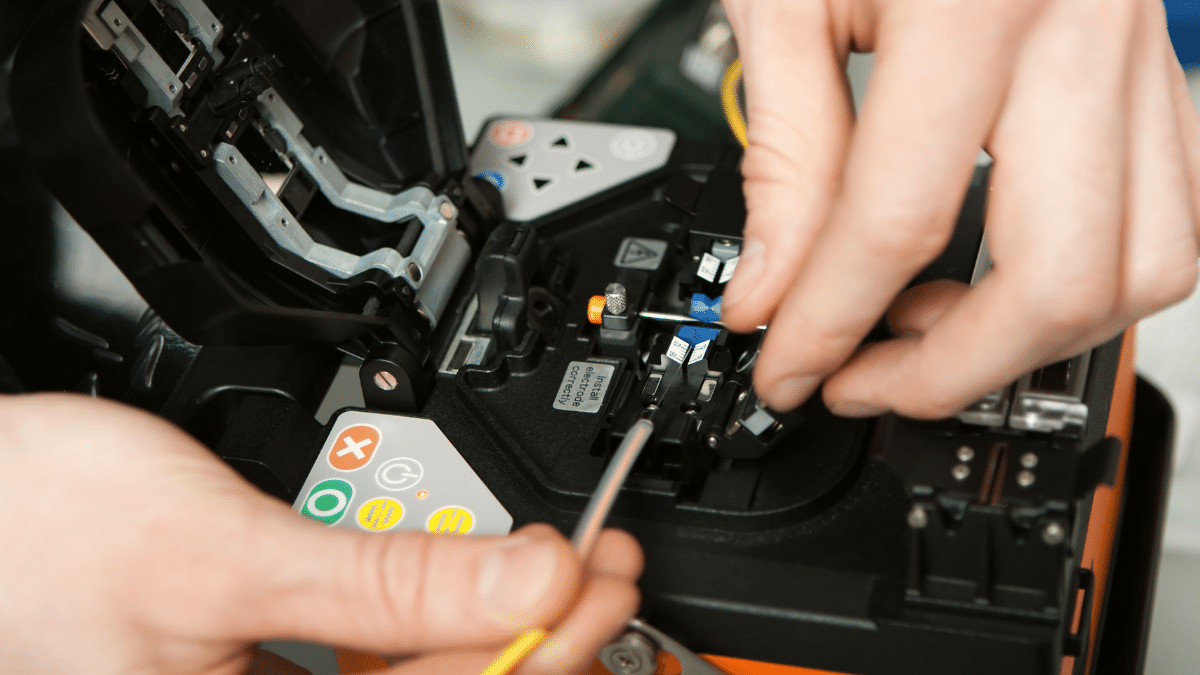
Make sure that you get yourself a microfibre cloth. Microfibre cloth will not leave lint residue when wiping a surface, so this makes it incredibly useful when cleaning the interior and exterior of a splicing machine. You will also require fibre optic alcohol. However, if you aren’t interested in purchasing expensive ‘fibre’ variants of cleaning alcohol, then make sure you buy a bottle of 99% Isopropyl from any other technical retailer. Isopropyl is also used to clean computer accessories and parts, so it is widely and cheaply available.

  1. Make sure that you apply enough isopropyl to the microfibre cloth so that when you wipe with the cloth it is damp enough to clean, but it must not allow any alcohol to pool up in recesses in the machine.
  2. Using this measure you can literally clean every part of the machine, both on the exterior and interior, NB: apart from the electrodes and the camera lenses within the splicing machine. We recommend cleaning the interior before the exterior so as not to transfer any dirt into the machine.
  3. Use a small cotton earbud with isopropyl in order the get any hard-to-reach places in the machine. Use this method to clean the camera lenses, but ensure that you are using a brand-new, clean earbud for each lens, and apply less alcohol. Rub the lenses softly in a circular pattern.

Get yourself a high-quality, soft-bristle paintbrush. It needs to be high quality so that it doesn’t lose any bristles in the machine. A soft-bristle paintbrush can be used to clean the fusion splicing machine’s V-groove (where the fibre sits before splicing) as well as the heating tray (where the heat shrinking of the protector takes place). This is how you can remove dust and tiny pieces of debris within the machine more regularly. Regular cleaning; that’s how to maintain a splicing machine.

Cleaning & Maintaining Electrodes

Electrode maintenance is crucial if you intend on ensuring perfect splices. No matter the splicing machine, if the electrodes are clean and able to project a perfect arc, then the splice will be good.

Almost all electrodes are installed by a screw-clamp within the machine. This makes removing the electrodes easy. Your machine might require another action when removing or replacing electrodes, so make sure you know what you’re doing before-hand. Additionally, some official resellers of electrodes might rescind your warranty if you remove or replace electrodes yourself, so only perform this action if you are completely sure you are able to.

When you remove the electrodes they can be cleaned with alcohol and a microfibre cloth. Please make sure that you use a limited amount of isopropyl because if there is any residue of alcohol on the electrode when you arc, you can re-burn the electrode and therefore re-dirty the electrode.

PS: here’s a little trick. Place a formula of a teaspoon of baking soda and a teaspoon of salt diluted in warm water into an aluminium container. Place the electrodes in the formula for a few hours, and then take them out before wiping them clean as above. This will remove all the oxidation stains on the electrodes, giving them some more life. I have used electrodes for over 5000 splices using this method of cleaning. Learning how to maintain a splicing machine sometimes requires a few tricks.

Calibrate Your Fusion Splicing Machine

And then calibrate your machine again, and again, and again. You cannot calibrate your machine too often. A good rule-of-thumb is to calibrate the splicing machine at the beginning of each new day of splicing, and then recalibrate in the same day after 100 splices (if you’re splicing often ie. in trays), or halfway through the working day (if you’re splicing outside in joints and terminations). This is because of a number of factors:

  1. Temperature and humidity changes during the day can result in your machine using the same measurements for splicing in the morning as in the afternoon… when this shouldn’t be the case. Make splicing machine calibrations as temperature and humidity changes.
  2. Your machine is running hotter and/or there is dirt and residue from the day’s operations, changing the temperature and profile of the arc. Therefore you will need to recalibrate your splicing machine.

By not recalibrating your machine, you or your technicians will need to do more splicing, which will gradually result in more wear-and-tear on your machine, and a valuable loss in time on the job.

Enjoy working with a well-maintained fusion splicing machine. If you keep your machine clean, the electrodes in tip-top shape, and you ensure that calibration is done regularly, you’ll be splicing sub 0.01db most of the time. And that, ladies and gentlemen, is how to maintain a splicing machine.

Remember, if you need splicing machines, then don’t hesitate in visiting HeaviTech’s splicing machines for sale page. We can supply you and your business with Sumitomo, Fujikura and Comway (or any other brand that you might need).

What Is OTDR?

When becoming a fibre optic specialist or installer, you will quickly have to learn the ins-and-outs of OTDR and its measurements. If you are new to the concept of OTDR this post might be very helpful as a short introduction. If you are experienced with the functioning and measurement of an OTDR, this post might give you a little more insight than you previously had. So take a look:

Optical Time Domain Reflectometer (OTDR)

Yip, that’s what OTDR stands for, and it’s quite a mouthful. Simply put, the OTDR is the equipment and the measurement used to check the ‘health‘ of a fibre cable post-installation.

When a measurement is taken with an OTDR we call this the ‘OTDR trace‘. A trace offers the user a graph measurement of the cable, forming a ‘picture’ of what the cable’s integrity might look like. This makes it incredibly helpful when determining if there is a break and where the break occurs along the cable.

Secondly, the OTDR measurement can also be used to check if there are losses along the fibre cable. These losses might be caused due to attenuation, bends or bad splices. An OTDR is so accurate that it can even determine minute losses during instances of good splices.

OTDR & Power Meter

An OTDR is best used in conjunction with a power meter. Why? Because an OTDR is determining the profile of a cable from a single input, and the best way of checking whether the correct losses are measured is with a power source and power meter at both beginning- and end-of-run.

For example: a power meter might pick up that a cable’s end-point is experiencing higher-than-expected losses at the end-of-run. A technician would then use an OTDR to ‘trace’ the cable and find out exactly at which point these losses are being experienced.

During the installation of a fibre network, it is important that a contractor or technician records both a power meter test and an OTDR trace to prove that the line is working to the correct standard. This means that, should there be an issue at a later date, technicians can compare new trace results with older ones, determining that something has occurred between the installation and breakage.

Backscatter Light

Another reason why a technician should always have a power source and power meter handy is because they emulate the transceivers within a working link. An OTDR uses a slightly different method to determine its measurements. An OTDR uses the backscatter of light (transmitted by the OTDR machine) within the cable to determine the amount of loss accumulated, and the location of said losses.

Within a fibre cable there are tiny imperfections, manufactured on purpose, to ensure a reasonable amount of backscatter light for measurement purposes. Additionally, there is more backscatter along bending points and splices within the cable. The OTDR receives the backscatter light, and by clever use of speed and power it can determine the integrity of the cable at an exact point.

As the fibre cable is tested at points further from the OTDR, the attenuation and light loss is experienced more greatly. This means that an OTDR trace will always show itself as a depreciating line graph (unless there is significant reflection off a connector or splice).

An OTDR Graph Measurement

The above is a very basic example of the OTDR trace. As you can see, the graph is a representation of the fibre cable in both distance and and light attenuation. Because attenuation increases as a result of distance from point of contact for the OTDR, the graph will be depreciating.

Reflectance is a good indicator of what is occurring along a fibre line, and the OTDR (and the operator) uses reflectance dB’s to determine what events are taking place. For example, the first event on the left of the graph marks a splice. Due to the joining of two fibre end-points there will be an imperfection through which light is lost. The worse the splice, the higher the dB loss, as there will be less reflectance.

Sometimes high reflectance, such as the event taking place in the middle of the graph, indicates a connector or junction that irregularly reflects a larger amount of light back toward the OTDR. In rare instances, two different makes of fibre cable can result in a ‘gainer’ or ‘loser’ during splicing points. This means that one fibre with a smaller core runs into a fibre with a larger core (and higher attenuation) creating a ‘traffic jam’ effect, creating higher or lower reflectance (depending on the direction of testing).

Test Both Ways

Because of the varied results of an OTDR, and the likelihood of a result being questioned, it is always important to collect two trace results of a fibre cable: first in one direction, and then in the other direction.

Doing this will eliminate any gainers and losers as a result of different cable quality (when two different types of cable are being used). It will also ensure that splice losses and reflectance is being measured accurately. Furthermore, testing the launching point from either end of a fibre cable can only be done from the point in question. An end-of-run result on the OTDR will not provide the necessary information needed to determine if the fibre is terminating correctly (or even where you want it to terminate from).

This small article is, as mentioned, just a short explanation on what OTDR is and how it works. If you require more information on fibre optic testing equipment make sure that you contact Heavitech, and I’ll provide you with as much help as possible.

The Language of Fibre Optics in South Africa

For anyone joining the fibre optic community for the first time there is plenty of jargon for you to learn. Make sure that you understand some of the following terminology so that when talking to a contractor, client, salesperson and specialist you can make a valuable contribution by understanding what they mean. Hey, it always takes time settling into a new industry, so relax; this just might go toward helping you though.

Singlemode Fibre: Singlemode fibre is a type of fibre cable used for most fibre developments. Essentially, it is a fibre cable with a much thinner core than a multimode cable, streamlining information transferal via different light-wavelengths down the glass ‘tube’.

Multimode Fibre: Contrary to the above, multimode fibre was considered to be the future of fibre development as the larger core allows more space for the transferal of information down the glass ‘tube’. However, as technology advances, the transceivers on either side of the fibre line are becoming so adept at transmitting information that it is not the core space that is the issue; rather it is the speed at which messages are carried. Therefore, multimode is slowly becoming obsolete over the much quicker singlemode variant.

Cladding: Fibre cladding is the synthetic compound used to protect and cover the glass fibre. Don’t mistake cladding for the outer buffer on the overall fibre optic cable (these two terms often get mixed up and confused). The cladding usually takes different colours in relation to the fibre colour code spectrum. These colours are arranged in order as follows: Blue, orange, green, brown, slate, white, red, black, yellow, purple, magenta, aqua.

Buffer: Fibre buffer is the thicker compound that encompasses many fibres and their cladding (or sometimes a single fibre and its cladding). Often a buffer will also incorporate a ripcord (to assist the technician in opening the buffer), a strength-member, and sometimes a protective sheath.

Wavelength Division Multiplexing: This concept lies at the heart of the success of singlemode optical fibre (and fibre optics as a whole). By transmitting information in different wavelengths of light down a fibre optic cable, you can essentially transmit more than one message at exactly the same time. Additionally, information transmitted in this way can work bidirectionally (going in both directions simultaneously).

Fibre Splicing: Fibre splicing is exactly that: splicing or ‘bonding’ two endpoints of a fibre. This means that a break in a fibre line can be repaired, or a fibre line can be extended or shortened at will (although there are obvious pitfalls, because the more splices there are, the higher losses there will be). There are two types of splices: there are fusion splices (which involves ‘melting’ together two endpoints VERY accurately through the use of an electrical arc) and mechanical splicing by mechanically joining two endpoints and crimping them together so they stay fixed in their position.

Fibre Transceiver: This device holds the power behind a fibre optic network. A tranceiver is able to transmit AND receive information through a fibre optic cable via light wavelengths, and then convert them into electrical signals (the standard form of communication on devices, breaking down information into various code languages).

Duplex System: A duplex fibre system is a clever way of alleviating the stress on a single fibre pathway by dedicating two fibres to the communication between two points. Information gets sent in a single direction down one line, and then visa versa with the opposing line.

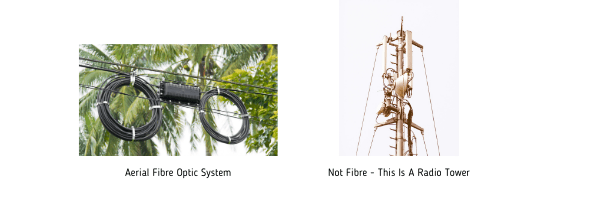
Aerial Fibre Network: To the layman, an aerial fibre network gets confused with aerial towers used for radio frequency signals. For aerial fibre, think of it as a replacement for traditional telephone line poles. That’s exactly what it looks like.

Underground Fibre Conduit or Fibre Duct: This is pretty self-explanatory. Although the system often costs a lot more than an aerial system, underground fibre conduit or fibre duct is a good way of protecting the fibre network. Sometimes, fibre cable is laid out in trenches WITHOUT conduit or duct, but this is a very risky form of installation. Fibre cables are Floated or Blown into fibre ducts by using specialised machinery, and the cables can be accessed and distributed within manholes.

Visual Fault Locator: By using a simple laser module, fiber breaks can be exposed. If a VFL is shone into one end of the fibre, a bright light will appear on the other open end. This tool is used by technicians to identify fibre endpoints in relation to the side of the VFL, or it can be used to find breaks in the fibre itself.

Power Meter & Light Source: Fibre optics light sources are measured in decibels (just like sound, although this pertains to light too). A power meter is a device used by fibre optic technicians to measure the output of decibels from a light source on the opposite side of a fibre optic cable. If light is attributed to the cable at a certain strength, the amount of dB (decibels) loss will determine how much power is being lost in the run of the cable.

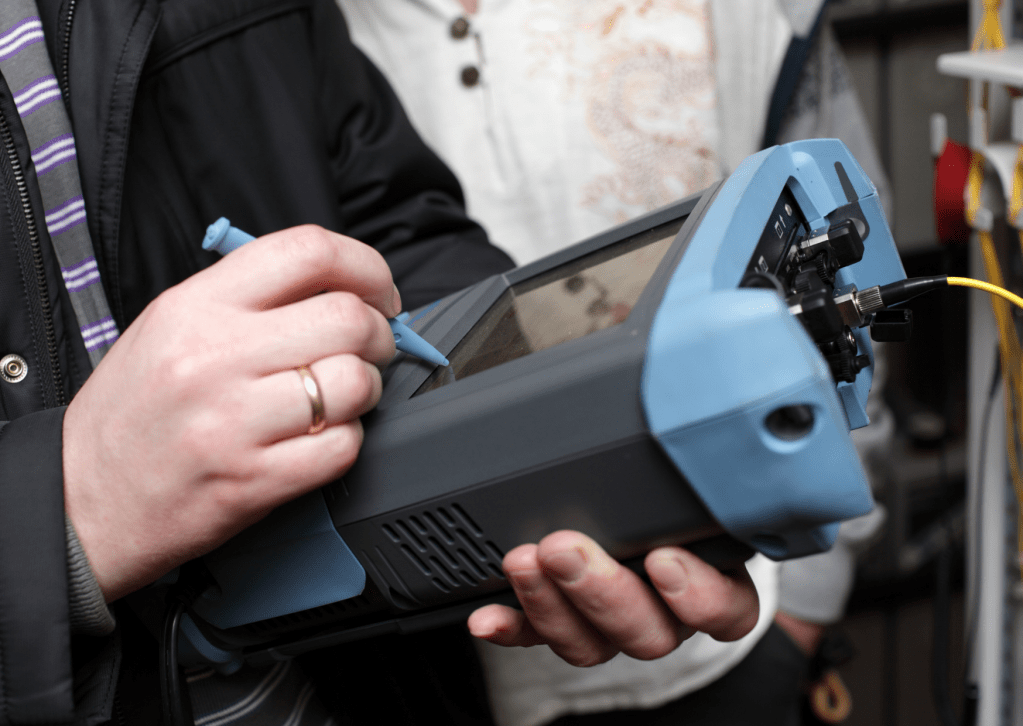
Optical Time Domain Reflectometer: That’s a big name for quite a simple machine (simple in theory, but difficult to master). An OTDR machine ‘traces’ a fibre cable: this means that it plots the cable from one point to another on a line graph, using the ‘backscatter’ of light as a way of measuring dB loss. dB loss is best measured with a power meter and light source, however to understand where certain ‘events’ lie on a fibre optic cable an OTDR is required. We will do a full blog on the OTDR at a later time so that you may fully understand how the machine works.

Singlemode Fibre for the win!

So, this has been on the cards for a long time: should we still be using multimode fibre when it comes to FTTX? The short answer is ‘no’. Singlemode transceivers have typically always been more expensive than multimode tranceivers, however multimode cable has always been considered a little more expensive than singlemode cable. So there has always been a bit of a payoff for choosing one over the other. However, to get the gist of this particular article, we have to understand the exact difference between the two kinds of fibre optic cable and their traditional uses.

What is Multimode Fibre?

Multimode fibre is pretty much a self-explanatory term: data is transmitted down a fibre optic cable via light. In a multimode fibre cable the core is much larger than that of a single-mode fibre. This means that a variety of transmissions can be made down the same length of fibre at the same time. This is because the core is wide enough to accommodate a number of different wavelengths; ie. 850, 953 and 1300nm.

What Is Singlemode Fibre?

Contrary to multimode fibre, singlemode fibre can only transmit information down a single pathdown the cable. This doesn’t mean that one packet of data exists within the cable at any one time: packets of data immediately precede each other. The difference is that traditionally it was believed that multimode would be an easier way to transmit more volumes of data.

The Rise of Singlemode Fibre

The above case did not prove to be true; multimode fibre allows for much more light refraction within the core. This means that the db loss is considerably higher. In some wavelengths a multimode fibre can experience losses of 3.00 db/km, and this is without losses as a result of splices, bends, etc.

Additionally, at the point of transceiver, a multimode fibre suffers from DMD (differential mode delay) as time is taken to determine which wavelength the message is being relayed. At this point in time, the only real reason why multimode fibre is being utilized is due to the cost of singlemode duplex network in comparison to that of a multimode network. The cost can often be double that of a multimode fibre network! Well… that is until now.

Singlemode networks are fast becoming more cost effective than multimode networks. Why? Well for starters, the sheer volume of data that we use nowadays means that the only way fibre can keep up with our demands is by utilising a duplex SM or bidirectional SM network (something that can be scaled up to terabits in future). This means that more singlemode transcievers and SFP modules are required, which in turn means more production, which is resulting in a drop in the cost of production. Furthermore, it is actually more expensive for fibre cable businesses to produce multimode fibre due to the complexity of the cable.

Let’s Conclude

Singlemode fibre is becoming cheaper, and that doesn’t just mean the cable: that includes transceivers and modules too. Secondly, depending on the network design, the scalability of a singlemode fibre network will keep us invested in fixed P2P for the considerable future. The only place where multimode fibre will continue to be used would be on premises networks that require much cheaper modules: think mining (over shorter distances, of course).